-1.png?width=400&height=100&name=PVHQ_Primary_Horizontal_Black-Blue_NoBox%20(1)-1.png)
.png?width=1200&height=628&name=IT%20security%20article%20hero%20(1).png)
Resource
%20(1).png?width=48&height=48&name=Pallet%20Vision%2011%20Imagery%20(2)%20(1).png)
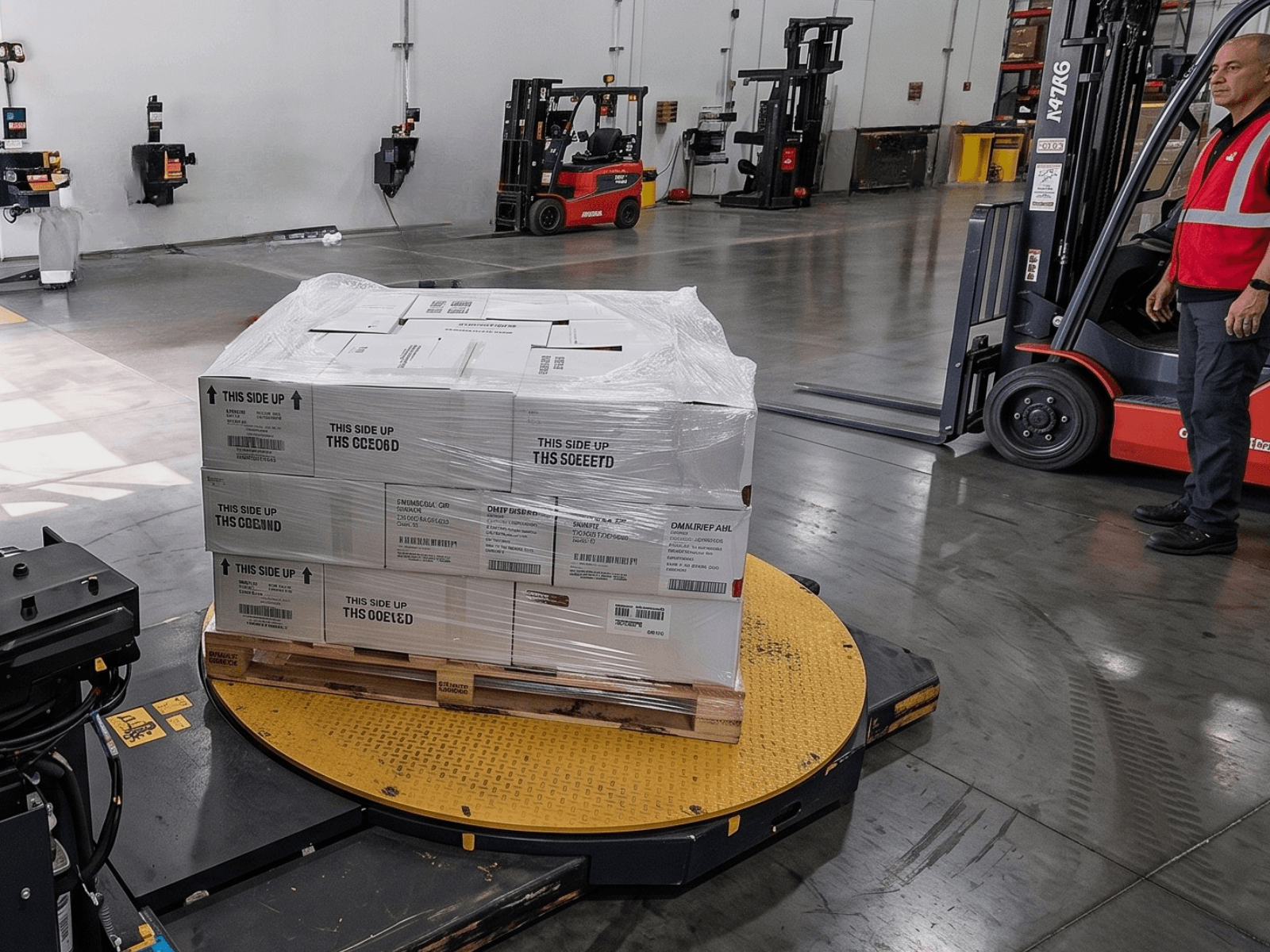
I spent years on shipping docks before I ever built something that mounted on one. Long enough to notice that the most expensive spot in a lot of facilities is the few feet of floor around the stretch wrapper, and almost nobody in the building is assigned to watch it.
Here is what happens there, in plain sight, every single day.
A pallet gets wrapped. It looks fine. It goes on a truck. Roughly 1 in 51 shipments ends in a damage or loss claim, and the average LTL claim runs close to $3,777 (Flock Freight, 2023). Three weeks later, one of those claims comes back, and the shipper has no record of what that load looked like when it left the building.
The claim gets denied. Not because the load was bad, but because there was no proof it was good. The pallet was probably fine. The paperwork was not.
Incomplete documentation is the single most common reason freight claims get denied, and under NMFC minimum documentation requirements the burden of that proof falls on the shipper, not the carrier.
Industry estimates put the share of claims lost to weak proof of condition at well over half.
Somewhere in that same building, people are documenting loads by hand. Walking each pallet, taking phone photos, typing notes, and filing them somewhere a claims adjuster will never find them in time. A facility wrapping around 1,600 pallets a month, at five minutes of manual logging each, spends north of $40,000 a year on a task that produces almost nothing usable when a claim actually lands.
And that's the cost when nothing's gone wrong yet. When a claim actually lands, the real cost isn't the documenting, it's the scavenger hunt for whatever documentation might still exist. Someone digs through a phone's camera roll, a shift log, an email thread, and a stack of handwritten notes, trying to reconstruct what a pallet looked like three weeks ago. Half the time the photo's out there somewhere and nobody can find it before the claim deadline passes. The other half, it was never taken at all.
It is the kind of cost that never shows up as a line item, because it is spread across every shift in five-minute pieces nobody adds up.
Stretch film is rarely measured, so most operations use far more than a load actually needs. Operators wrap for peace of mind instead of to spec, adding a few extra passes after a bad shift or a shaky load, and the extra revolutions add up across thousands of pallets a month. A study in Packaging Technology and Science found that getting containment force right, not more film, the correct amount, improved how much a load sags and shifts in transit by as much as 81 percent. Wrap more than a load needs and you're not adding protection, you're adding cost with no return on it.
The waste runs around 30% of film spend in a typical operation. Robopac USA, one of the larger stretch wrapper manufacturers, reports that optimized machines and film-handling technology can cut usage by 30 to 55 percent, which means that much of what a typical operation applies today isn't adding protection, it's just excess nobody's caught yet.

Three leaks. Denied claims, documentation labor, and wasted film. Every one of them happens at or around the wrap point. And every one of them stays invisible for the same reason: nothing has ever measured what happens at the wrapper. That was the question I kept circling. Why has nobody put eyes on the stretch wrapper?
So we did. Wrap-point verification is the category, and the Intelligence Layer is the system. It mounts on an existing wrapper and captures weight, dimensions, wrap integrity, and load condition on every pallet, automatically, at the moment of wrap. Each load gets a Load Health Score. A low score means re-wrap before it ships. A high score means you hold documented proof the load left in good condition, captured without anyone walking the dock with a phone.
The point was never the camera. The point is that the three leaks stop being invisible. You get a record for every claim, the manual logging goes away, and you can finally see whether you are over-wrapping or under-wrapping instead of guessing your way through a roll of film.
I am biased. I built the thing, so do not take my word for the size of any of this. Every dock has the same issues but the impact is uniquely yours.
The Dock Leak Worksheet walks through the same three leaks, claims, labor, and film, and plugs in your own pallet volume to show what they are actually costing you.
PalletVision is the first wrap-point verification system that automatically captures weight, dimensions, wrap integrity, and load health at the moment of wrap. The Intelligence Layer mounts on an existing stretch wrapper and gives every pallet a Load Health Score before it ships, so facilities can prove condition at origin, cut manual documentation, and stop guessing on film.
